


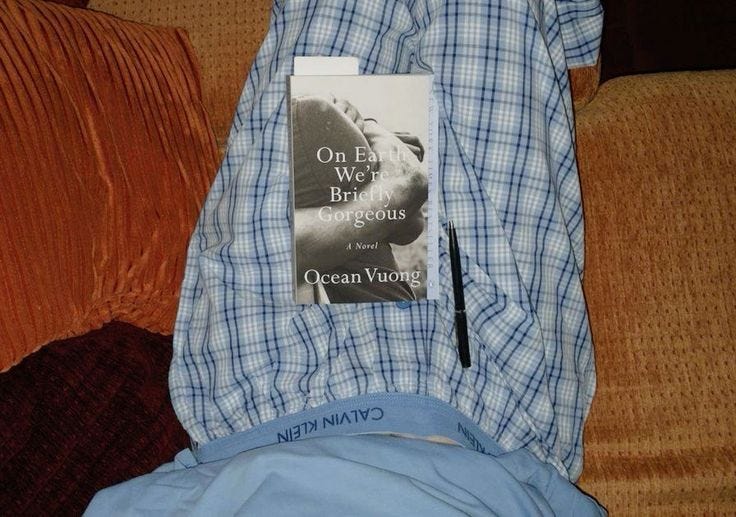
In TikTok compilations of “books for sad girls,” “books for sensitive girls,” and “books to make you cry so hard you throw up,” the list will almost always include Ocean Vuong’s On Earth We’re Briefly Gorgeous. More often than not on TikTok, the book is boiled down to a piece of literature that will “absolutely destroy (you),” as TikToker Suhani writes. Conversations around the book have heavily focused on the ways in which the book makes you feel, as well as its representation of the immigrant child experience. Among reader spaces on social media, there seems to be an agreement that this novel has the capability of changing the reader.
Before looking at others’ reviews of the novel on Goodreads, I first returned to mine, which was written on the last day of 2022. I began by saying, “Nothing, and I truly mean it when I say this, has ever felt me feel the way this book did.” When looking at other reviews, I find that this is not a unique experience. Just a short scroll through TikTok provides videos of people saying that everyone needs to read this book once in their life, that this novel changed their perspective on life, and that they cannot stop thinking about this book. It’s clear to me that Vuong’s novel is something that sticks with readers after it leaves them. Bookstagram user @ellereadsomebooks writes in her review of the novel, “this is one of the most beautifully written books i have ever read in my life. Vuong’s ability to spin words into gold and sentences into a melody is unlike anything I have seen before.” For many readers, this book has been a bridge to help them get into literary fiction, and it’s often spoken about as a good starting point.
In my review, I went on to write, “I have often thought about and written about the unknowable rage children of color feel in this country and this idea that we are all born with this rage inside of us… How do you put a name to all the centuries of being stolen from… How do you put a name to the rage that sits in your mother, and your mother’s mother, and her mother before her?” I knew when I was getting into this novel that it was going to primarily be a novel about the experience of having immigrant parents. But for others, this is not necessarily the case. When scrolling through Goodreads, I kept expecting to find others who had read this novel for the same reasons I had, and while there were some, there were not nearly as many as I expected. Despite this novel being first and foremost about the experiences of the queer, immigrant, Vietnamese man, the majority of its audience is only the first. Despite the very specific experience Vuong writes about, the reach of this book is far wider than just those who identify similarly to him.
Many reviews focused on how, despite this novel being fictional, it never once felt like that. Reviewer Emily May writes, “I found it difficult to believe this was fiction. There is something about Little Dog's story, a certain raw honesty and earnestness, that seems to come from a place of truth. Maybe because much of it does.” What seems to draw readers into this novel is the incredibly vulnerable rawness with which Vuong writes— it shows up in his poetry, as well as in his novel. Readers are hoping not just for entertaining writing, but also a sense of realness. Vuong’s vulnerability is almost intoxicating in this novel, something that the reader cannot get enough of. The experience of reading this novel does feel less like autofiction and more like a straight-up memoir; however, Vuong very adamantly holds to the fact that this novel is not a memoir or autobiography. Popular Goodreads reviewer Chai writes, “By the time you finish reading On Earth We’re Briefly Gorgeous, you will have understood what Ocean Vuong meant when he said, ‘I wrote a phantom novel.’ The phantom is about the past…the phantom clings to something long gone, inconsolable and beyond reach…and, ultimately, the phantom remembers.” The theme of memory is largely explored within the novel, and readers seem to care heavily about this factor. They enjoy the novel because it feels like a collection of memories more than it feels like fiction. There is a reality to it that other novels do not have, both due to its epistolary nature and the autofiction aspects of the novel.
Many reviews speak about seeing this novel on front tables in bookstores, seeing the beautiful cover and title, and then ultimately not buying it. Eventually, however, they do end up purchasing it, and write that they regret not buying it earlier. The novel seems beautiful enough on a superficial level, but takes a bit of urging to get people to pick it up. Reviews write about thinking it’s nothing more than a pretentious man’s memoir, and while some reviewers still think it is after reading the book, most agree that they had misjudged the book. The concept of pretentiousness comes up often in negative reviews of the novel, with many thinking that Vuong’s writing is superfluous and flowery. Vuong, first and foremost, is a poet. While some readers love that he is able to write so beautifully within a novel format, others find that it simply does not work. Roxane Gay writes, “The prose was, perhaps, too beautiful, too resonant, without enough story behind it.” This seems to be the biggest divide between readers— those who enjoy the novel love his beautiful prose, while those who dislike it feel like the story falls flat without enough plot behind it.
Ultimately, the most positive reviews of the novel all say the same thing— that this novel made them feel things they had never experienced while reading. Vuong is able to draw out something incredibly raw from his readers and lets them explore their pain through his. Vuong’s novel is a form of bibliotherapy for readers, a place where they can take their pain and understand it through the exploration of another’s. By being able to watch Little Dog struggle through his own identity and circumstances, readers can both empathize with him as well as project their own selves onto him. More than simply a tool to explore the craft of writing, the novel is a place for readers to be able to explore their interiority through the exploration of characters on the page.
While Brouillette argues that Wattpad and YA are the places for new-age bibliotherapy, I argue that that is not the only place where it can take place. It’s clear to see that the reactions to Vuong’s novel are incredibly intense, and while they may not provide the happy fuzzy feeling a YA romance might, they provide the reader a space where pain can be explored without them being hurt themselves. Brouillette writes “The term "bibliotherapy" was in fact coined amidst the early age of cinema, in 1916, by Samuel Crothers. In a satirical dialogue with the author, the fictional bibliotherapist imagined that the unique value of reading was its capacity to produce almost any affect — to stimulate or subdue, annoy or sooth, in response to basically any modern need or situation.” Reading, as understood by Crothers, is a place where any human emotion can be displayed. By producing any human emotion, the novel is able to reflect any type of human experience. Brouillette’s understanding of bibliotherapy and the way that it works for Wattpad and YA informs a greater understanding of the novel as a whole. Rather than only these specific novels being a place where care takes place, the novel as an entity exists for this reason.
Brouillette goes on to write, “In contrast, in more recent bibliotherapeutic literature, descriptions of reading for therapy often set out a more straightforward practice of holding one's life up against a representation in fiction, to develop one's own "self-concept" via comparison, in a way intended to be affirming and de-stigmatizing. You would see that your own psychic situation, however painful, was not unique.” Seeing one’s self reflected in the pages of literature is what makes Vuong’s novel, and many others, so incredibly popular. One does not have to be queer, Vietnamese, an immigrant, or a man to understand the pain that Vuong writes about within his novel. Pain is the most universal experience in the world, and the ability to empathize and see yourself within it is what makes literature so important, especially today. To be able to see another struggle in the way you do is the ultimate comfort. Knowing, that despite how painful it is, you are not isolated in your pain is the real and true need for literature.
At the end of my review, I wrote, “Tim Kreider once wrote, “If we want the rewards of being loved we have to submit to the mortifying ordeal of being known.” If anything has ever made me feel seen, made me feel as though I'd been ripped apart and placed on a page, it is this book.” My own experience with this novel informs how I understand the novel works, and for me, the novel has always existed as a place to grieve. When it is too hard to talk about something in the real world, the reader can escape into another one. The reader can go into another world and can see the characters grow through what they have experienced. The novel, ultimately, is a hopeful thing. It is the ultimate reminder that, despite the horrors of everyday humanity, there is always a way through. There is always a way out.
sources
Brouillette, Sarah. “Wattpad’s Fictions of Care.” Post45, 22 Mar. 2023, post45.org/2022/07/wattpads-fictions-of-care/.
the ending about using media as grief and there always being a way out hits so close. this is beautiful!!